Financial analysis · Rio Linda, Sacramento County, CA
A $2.5M truck yard, and what it really costs to open
A truck repair operator found a 4.8-acre yard zoned for his use and listed under budget. We traced what the county would ask for, mapped it onto the lot, and priced every line before he made an offer.
- $2.5M
- listing price
- $2.60M to $2.83M
- all-in if the county asks only for the minimum
- $3.12M to $4.50M
- all-in if the county applies today's site standards
The question
The buyer runs truck and trailer repair. He wanted 2 to 5 acres with an open yard, to buy, for under $3M all-in.
This yard looked like a match on paper. It was listed at $2.5M for 4.78 acres, fenced, on a rock base, with a 6,480 SF shop. It is zoned county M-1, where truck and trailer repair is allowed by right, with no use permit and no hearing.
So the question wasn't whether the use is allowed. It was what the county would make him build before he could start, and whether the total stays under $3M.
What the records showed
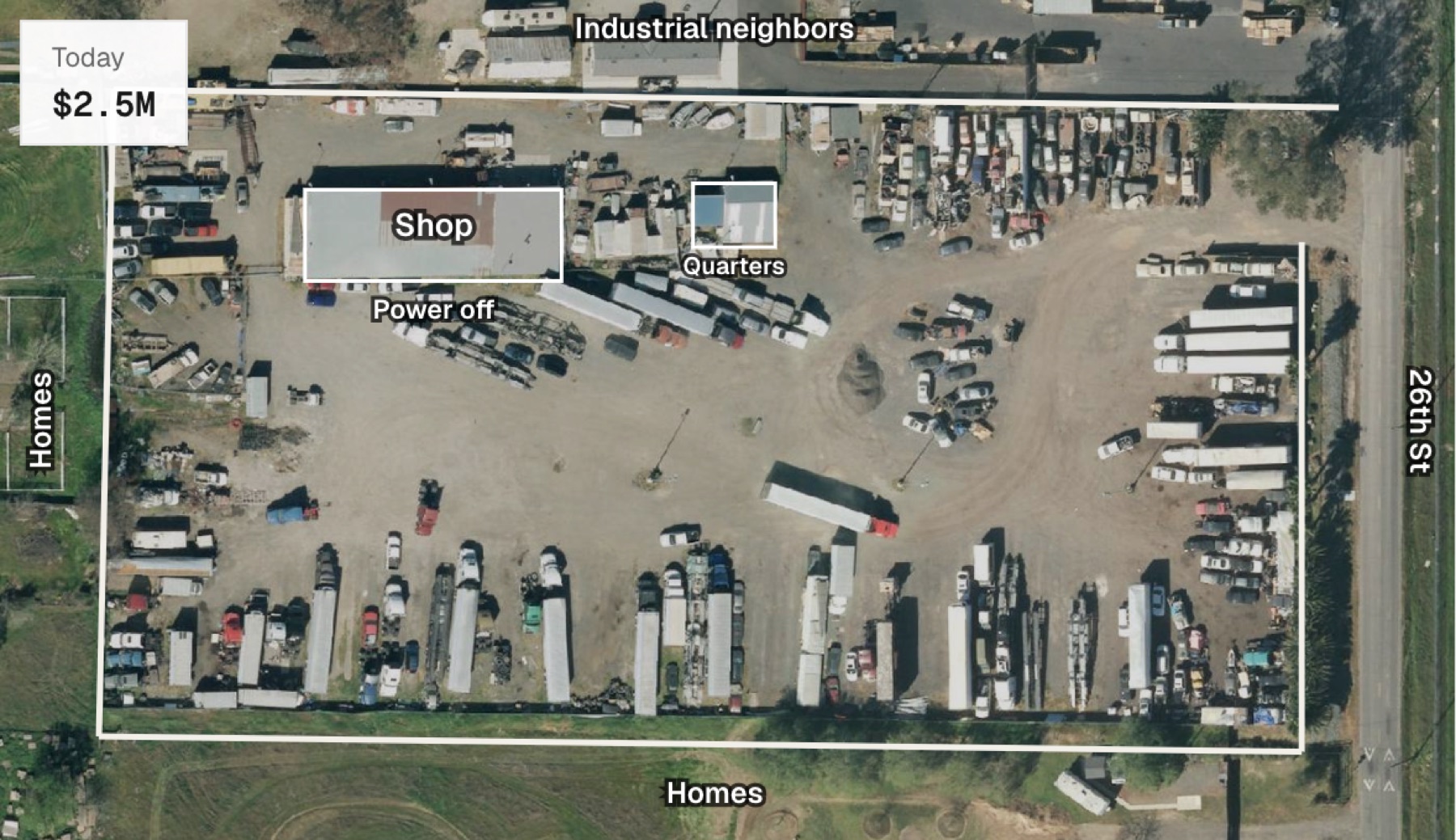
Zoning tells you what's allowed. The site's own records tell you what the county will ask for. Three records changed the answer:
- 2022: someone opened a pre-application with the county for a truck terminal and repair shop on this site. It was never filed.
- 2024: a county planner wrote in the public processing log:
"Storage was only established use. Anything else including new buildings will require updating development standards on site."
- 2025: a county electrical safety inspection was requested and never finished. The power has been off since about fall 2024, and the utility won't reconnect until that inspection passes.
The 2024 note is the hinge. Repair replaces storage, so the county reviews the whole property before it issues a business license (zoning code 5.9.1.E). That review is where today's standards come in. Homes sit on the south and west lines, and those standards are written for exactly that edge.
Stage 1: the minimum to open
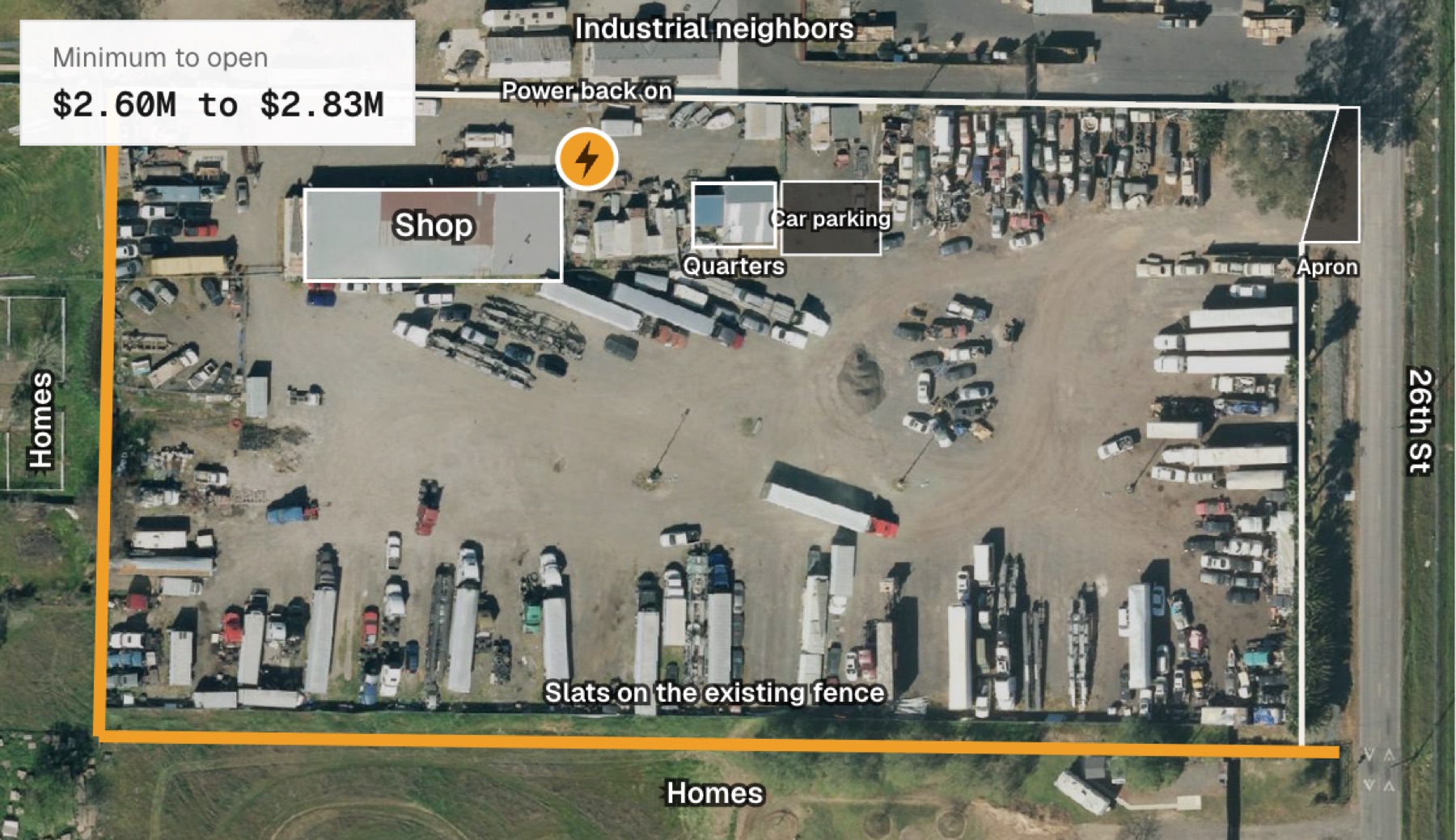
$95K to $328K one-time, $2.60M to $2.83M all-in. Open about 2 to 4 months after closing.
This is the light path, where the county accepts the existing fences and asks only for parking and lighting. Repair stays in the open yard, and every fence stays where it is.
- Business license with a site and parking plan review. Licenses don't transfer, and a planner has to approve a plan for the whole property first. About $263 license and up to $505 review. Zoning code 5.9.1.E.
- Power back on. A county electrical safety inspection, then the utility reconnects. This doesn't trigger a site review, so the seller can finish it before closing. About $110 to $225 permit, plus any repairs.
- Screen the yard on the south and west lines. Open-yard repair is allowed only behind a screen. The fabric on the south fence and the open chain link on the west don't count, so slats in the existing fence are the minimum. Zoning code 3.7.9.H.
- Pave the gate apron and about 10 car stalls. The truck yard itself stays on rock. Only the dirt apron and the car parking must be dust-free once the use changes. Apron up to about $12K. Zoning code 5.9.4.B.
- Shield the yard lights so the bulbs can't be seen from the homes. Zoning code 5.9.4.G.
Stage 2: if the county asks for more
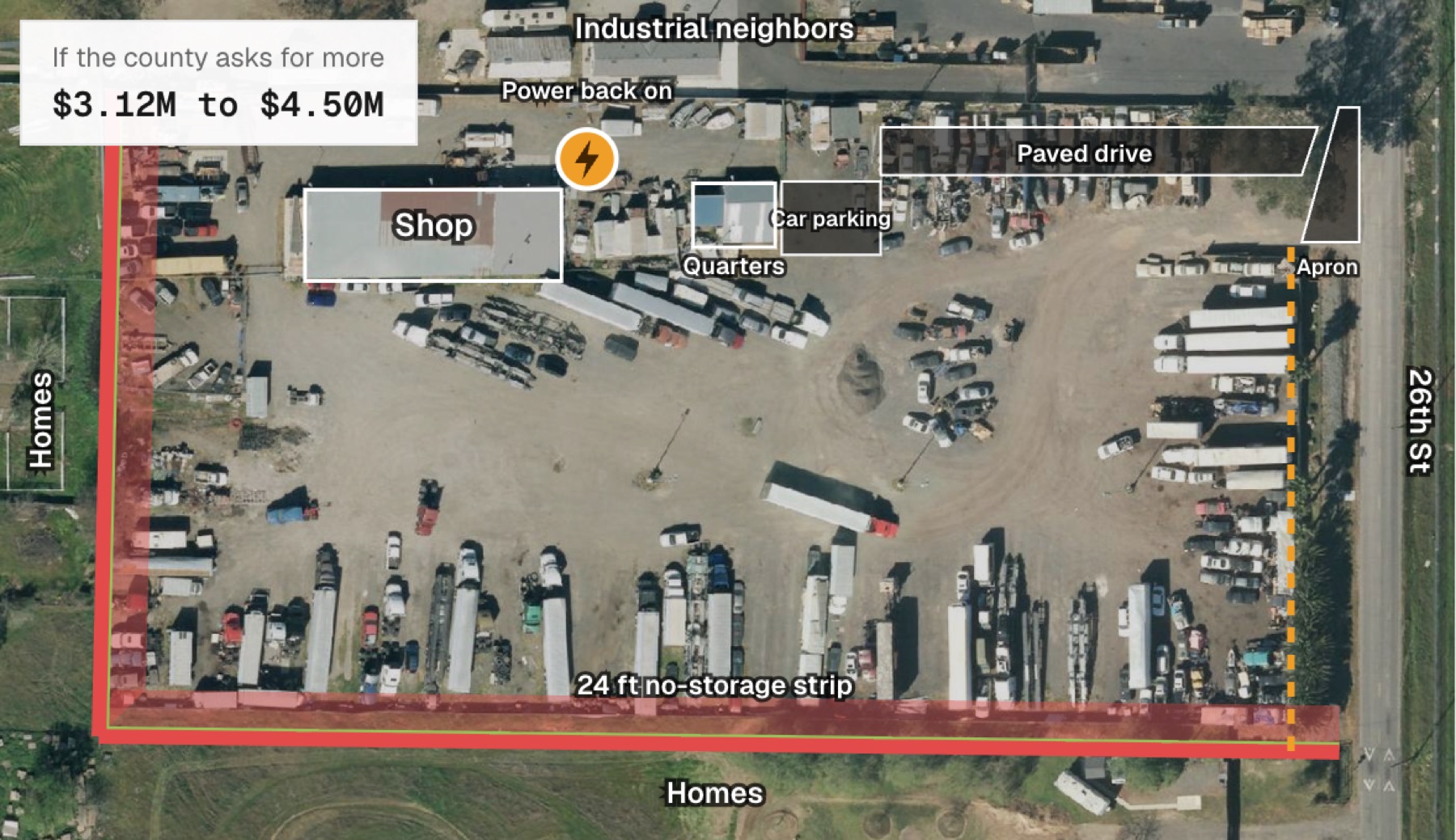
$623K to $2.00M one-time, $3.12M to $4.50M all-in. Open about 9 to 14 months after closing.
Because the yard backs onto homes, the county will probably ask for these at the license review. This stage is what makes the site "close, but".
- A 6 ft masonry wall on the south and west property lines, roughly 950 ft of it. It's required next to residential zoning for a repair use, and it's the largest single construction cost. Zoning code 5.2.5.E and 5.9.4.F.
- A 24 ft strip along those lines where nothing is stored. Nothing gets built there, but it takes about half an acre out of the yard. Zoning code Table 5.14.
- A 7 ft planted strip with trees inside the wall. It's the weaker of the two rules, so it's the first thing to negotiate. Zoning code 5.2.4.B.3.
- A paved drive from the gate to the parking. Trucks still stay on the rock.
There is a middle case. If the county keeps the existing fences with slats but still asks for the planted strip and the street work, the cost is $358K to $1.42M one-time, or $2.86M to $3.92M all-in.
Stage 3: repair inside the shop
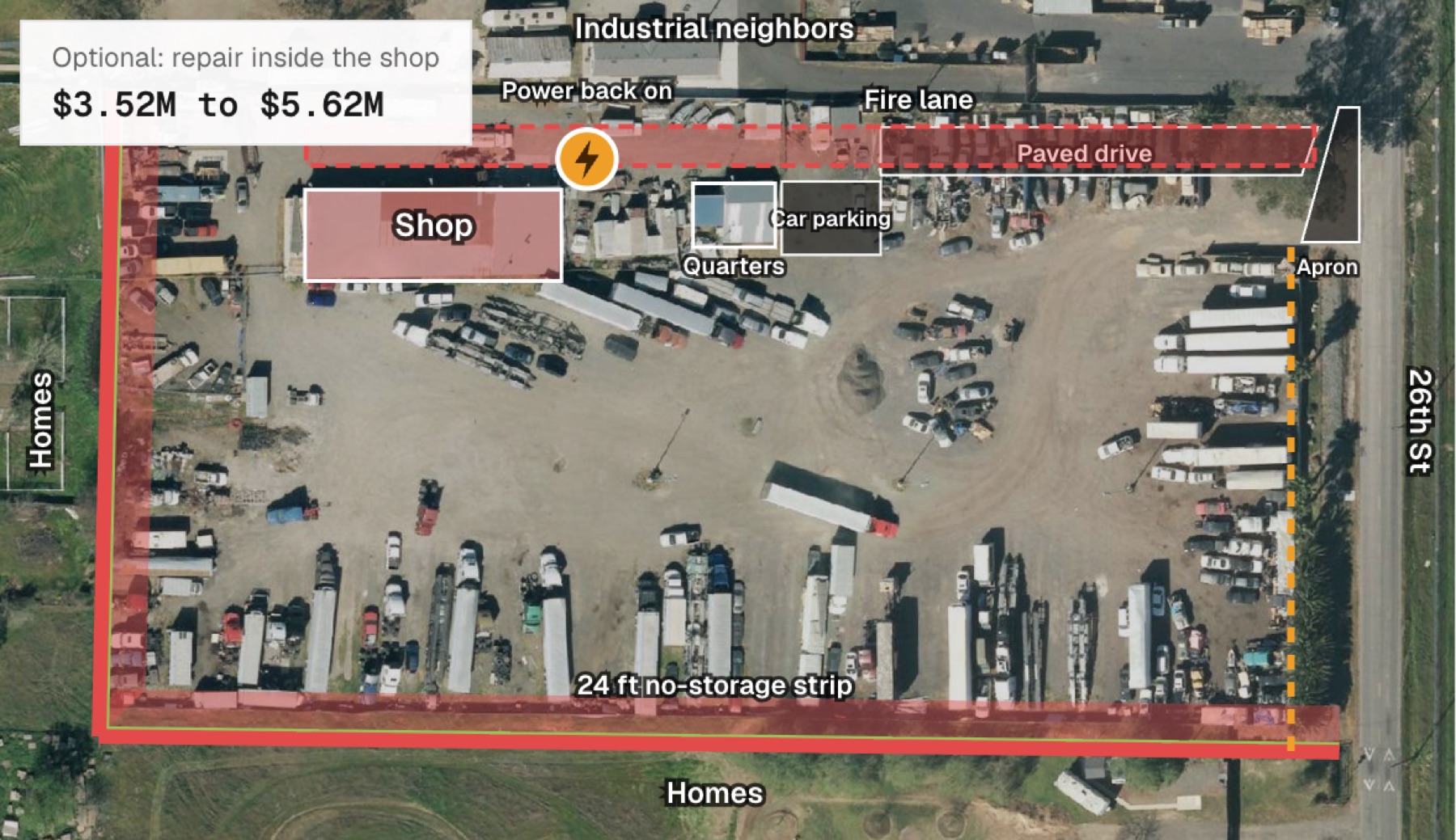
$1.02M to $3.12M one-time, $3.52M to $5.62M all-in, on top of the full site package.
Working on trucks inside the shop changes the building's occupancy, even with no construction. That brings sprinklers (the shop's 6,480 SF is over the local 3,599 SF trigger), exhaust, accessibility upgrades, a new certificate of occupancy and probably a 20 ft paved fire lane.
The catch is that this money may buy nothing. Old lease listings put the shop at about 11 ft clear, and our lidar puts the roof at 7 to 14 ft. A sleeper tractor stands about 13 ft 6 in, so most of his trucks likely won't fit through the doors. That makes yard-only repair the realistic plan.
What we ruled out, and what that's worth
Half of this kind of analysis is showing what the code doesn't require. Each of these came from reading the rule, not from assuming the worst:
- Paving the truck yard isn't required. Gravel is allowed where trucks are stored, and the existing rock base already meets that rule.
- No fire lane or sprinklers as long as no trucks are repaired or parked inside the shop.
- No wall or planted strip on the north line, because the neighbors there are industrial.
- Turning the power back on doesn't start a site review.
- The shop and quarters don't move for the 24 ft strip. Both sit well back from the lines.
In dollars:
| Choice | One-time saving |
|---|---|
| Repair only in the screened yard, with the shop kept for parts and tools | $393K to $1.11M |
| The county accepts the existing fences with slats instead of a masonry wall | $265K to $582K |
| Both together | $658K to $1.69M |
Where the numbers come from
Every line in the estimate carries a quantity, a unit cost, the rule that requires it and a source. Here is one line as an example:
6 ft masonry wall, west and south lines: 921 to 946 LF × $200 to $390 per LF = $184,200 to $368,940. Required by zoning code 5.2.5.E.2 and 5.9.4.F. The length was measured along the county parcel lines. Unit costs come from Caltrans bid prices for the Sacramento district and City of Sacramento permit valuations.
How the range works:
- Low end: the lowest public unit price and the smallest quantity the code allows, on every line.
- High end: Caltrans small-job prices and the largest quantity, plus a 30% construction contingency. It's a ceiling, not a forecast.
- Fees: taken from the county's published fee schedule, the fire district's standards and the utility's rules. Exact where a fee is published, an estimate where it isn't.
- Site facts: measured from our lidar data set, the county aerials and the parcel map (lot size, building heights, fence lines and how the yard drains).
- Checks: each cost category was priced and then re-checked line by line against its sources before the totals were added up.
The most expensive case (full site package plus indoor repair), by category:
| Category | Low | High |
|---|---|---|
| Site work (wall, landscaping, paving, fire lane) | $442K | $1.35M |
| Shop and fire upgrades | $264K | $774K |
| Design, studies and survey | $81K | $230K |
| Fire district and utility fees | $15K | $57K |
| County planning, building and environmental fees | $8K | $80K |
| Construction contingency, 30% | $207K | $625K |
| One-time total | $1.02M | $3.12M |
Some risks are kept out of the number on purpose because each is $0 if a test or a county reading goes the buyer's way. The largest is a fire pump and water tank ($202K to $332K) if the water flow test fails. All of them together could add up to $977K.
Annual permits and charges come to about $1,900 to $8,800 a year.
The answer
Close, but. The yard stays under $3M only if the county doesn't apply the full site package. The gap between the light path and the full site package runs from about $0.5M to $1.7M, and it can be settled before buying. A free public records request takes about 10 days and asks for the county's 2022 and 2024 letters. A county pre-application meeting costs $947 to $1,451.
So the advice was to spend about $1,500 and a few weeks finding out which number is real, before making an offer on a $2.5M yard.
Sources and method
- Sacramento County Zoning Code, chapters 1 to 7 and Table 3.1 (use table), landuse.saccounty.gov
- Sacramento County planning fee schedule, landuse.saccounty.gov
- County planning and permit records for the parcel (processing logs, 2022 to 2025)
- Sacramento Metropolitan Fire District fire prevention standards and local amendments
- SMUD service rules and commercial development checklist
- Caltrans Contract Cost Data (actual bid prices for District 3, Sacramento), escalated with the Caltrans cost index or the ENR 20-city index
- Our lidar data set and Sacramento County aerial imagery
The full estimate cites 204 public sources. Prices are in 2025-2026 dollars and change, so we confirm each one before any offer.